
Skip to content
Topology optimization

Search beyond the shape you already know.

Tell us what your motor has to achieve. Our automated design search explores geometries a parameter study can never reach, and it hands back manufacturable candidates that hit your targets with less material, inside every limit your project has already fixed.

Design freedom

One target. Two very different design spaces.

Parameter optimization searches inside a geometry that was defined in advance. Topology optimization can leave that family behind: the shape follows the physics, not the template. The dashed outline below is the target both searches are trying to reach.

Parameter optimization
W 272H 118

Width, height and a few hole positions are the knobs. The optimizer turns them until it reaches the limits you set: fast, cheap and easy to review.

But the rectangle stays a rectangle. No setting of those knobs ever reaches the dashed target, so every extra iteration only buys a slightly better rectangle. If the drawing you started from was already near-ideal, that is fine. Deciding that in advance is the hard part.

Topology optimization

Same starting point, but here the outline itself is the variable. Every point of it may move, material may open up inside, and the physics decides where mass earns its place. The shape settles onto the target instead of stalling short of it.

That is where the gains sit: the same performance from less material, or more performance from the envelope you already have. It costs a much larger search and far more simulation, which is precisely the part we automate.

Problem and solution

More iterations do not overcome a limited design space.

Every parameter has to be drawn before it can be varied. So teams resize, add a hole, move it. Attempt after attempt inside the same geometric family, until the schedule ends the search. The limit is not the engineers. It is that a drawing decided at the start quietly decides the result.

Conventional iteration

The clock ends this search, not the target.

Every round costs an engineer to propose a change, a simulation to check it, and a meeting to decide what to try next. Days pass between attempts, so a concept phase buys a dozen of them at most.

And because each one starts from the last drawing, they all remain variations of attempt one. When the deadline arrives, the best variation so far becomes the design, and nobody ever finds out how much was left on the table.

This search stops when the target is reached.

Requirements go in, ranked candidates come out. The loop proposes a geometry, builds a valid model, runs the physics and scores the result. Thousands of times, without waiting for the next review meeting.

Because the geometry is free, the space it searches really does contain the design you were aiming at. The same weeks that used to buy a dozen manual attempts now buy a complete search, and your team reviews a shortlist instead of settling for a compromise.

Automated design search

FEM design spaces

Three ways to define freedom inside one motor model.

How much may the optimizer change? That is a project decision, and it is the main dial on cost. The three rotor variants below run on the same model. They differ only in what the search may touch, from air pockets around a locked magnet to every material at every point.

Electrical steelMagnetAir
Cross section of a six-pole motor. The magnets stay fixed while the optimizer carves air flux barriers into the rotor steel at both ends of every magnet (0 percent progress).

Magnet locked

Fixed magnet

Your magnet, its supplier and its tooling stay untouched. The optimizer reshapes only the steel around it, opening air pockets that steer the flux into work instead of leakage. The cheapest efficiency you can buy once the line is running.

Fastest search
Cross section of a six-pole motor. Each magnet moves and resizes while air flux barriers form at its ends (0 percent progress).

Magnet adjustable

Parameterized magnet

The magnet stays a rectangle but may move, widen or flatten while the steel and air follow it. That opens the trade nobody can judge by hand: how little magnet volume still delivers the torque you need.

Wider search

Cross section of a six-pole motor. Scattered magnet material converges into a curved arc in every pole, with air flux barriers at its tips (0 percent progress).

Everything open

Free material layout

Nothing is prescribed. Magnet, steel and air settle wherever they serve the target best, and the magnet takes the shape the physics rewards, usually one no catalog has a name for. The widest search, and the one with the most room to win.

Widest search · most compute

How we choose between the three

How it works

From your requirements to designs you can review.

We define the targets and limits with you. The search changes only the parts you choose, checks every design against your requirements, and returns a shortlist for engineering review.

  1. 01

    Define the target

    We turn your performance targets, operating points or full duty cycle, packaging, materials, and hard limits into one design task. Optimizing across the cycle the motor actually runs, rather than a single rated point, is what makes the result hold up in service.

  2. 02

    Open the design space

    You decide what stays untouchable: shaft interface, stator bore, an existing magnet supplier, a paid-for tool. Everything else becomes searchable. Nothing you have already committed to is put at risk.

  3. 03

    Generate and evaluate

    The loop proposes a geometry, cleans it into a valid model, and runs electromagnetic and mechanical simulations against every condition: torque at each operating point, voltage and current limits, strength at overspeed, demagnetization, manufacturability. Candidates that break one never reach you.

  4. 04

    Review strong candidates

    You get a ranked shortlist with the trade-offs laid open, not one black-box answer. Every candidate traces back to the requirement it satisfies, so it can go straight into engineering review and on to the next validation step.

What you get

What topology optimization can improve.

Each project has different priorities. The search can reduce material use, improve performance, and automate time-consuming design work while keeping the requirements you define.

Lower material cost

Use less expensive material.

The search finds where material is needed and where it can be removed. This can reduce material cost while keeping the performance your product requires.

Efficiency and performance

Improve what matters to your product.

The search can improve efficiency, torque, or power density. It evaluates these goals together and shows you the best options for your priorities.

Faster development

Automate time-consuming design work.

The process creates, simulates, and compares designs automatically. Engineers can review more options with less manual work and focus on the strongest candidates.

Research results

Built, tested, and measured.

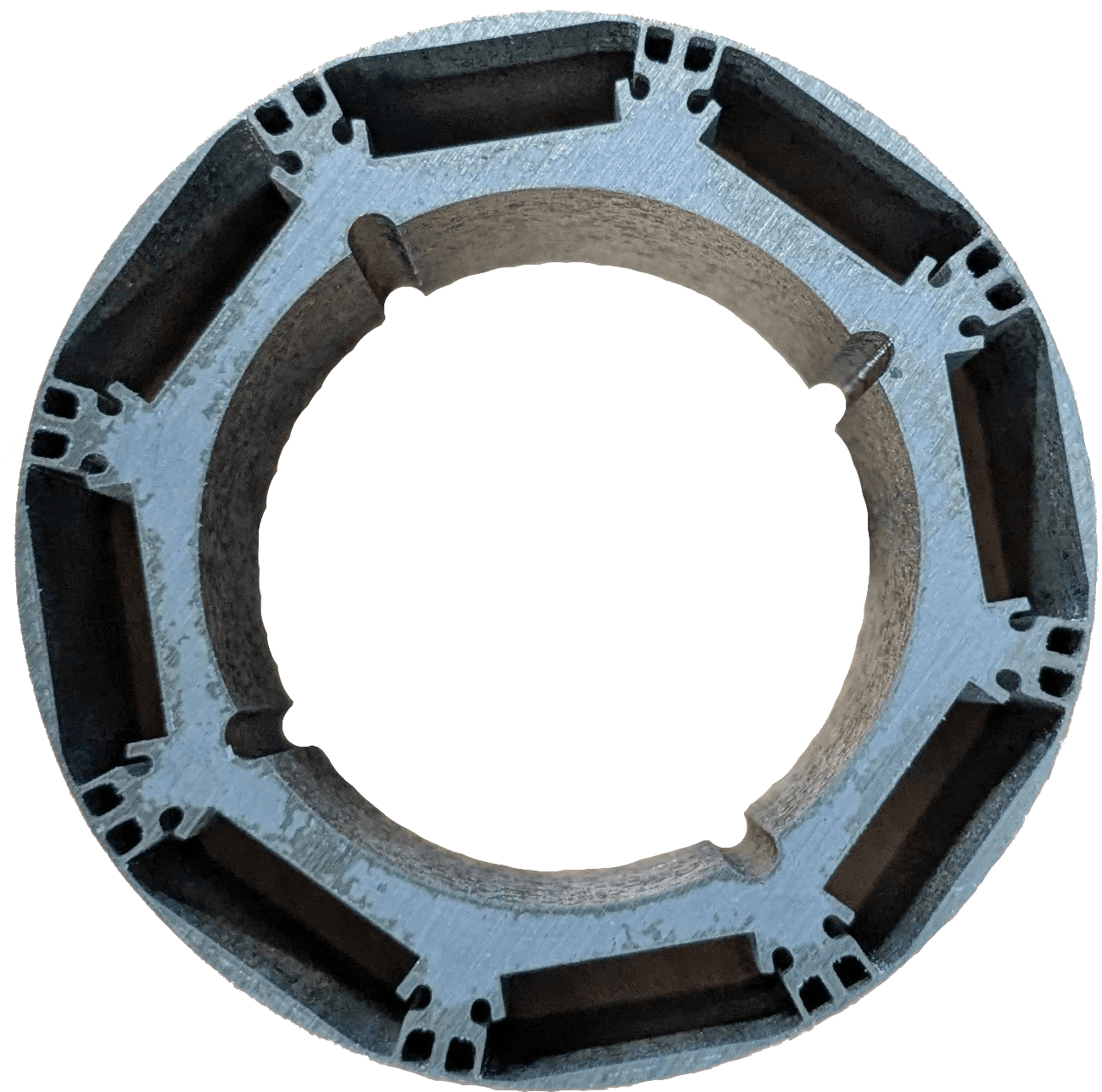
In his doctoral research at TU Berlin, Dr. Alexander Schugardt developed two optimized rotor variants, manufactured them, and tested them on a test bench.

Manufactured topology-optimized rotor developed in Dr. Alexander Schugardt’s research
Manufactured optimized rotor · Dr. Alexander Schugardt, TU Berlin

10%

less magnet material

The selected design used less magnet volume while maintaining the reference machine's simulated efficiency across the drive cycle.

2.4%

lower rotor mass

Changes to the magnets and air pockets also reduced the total rotor mass.

Built

and measured

Two optimized variants were manufactured. Back-EMF, torque, and efficiency were then measured on a test bench.

Read the full research case

Discuss a design challenge

Bring us the requirements your current geometry struggles to meet.

We will look at the available design freedom, the operating conditions, and the checks a useful optimization would have to pass.

Book a call